Showing posts with label process. Show all posts

Sunday, August 8, 2010

A 24 Year Party


I've lived two lives with this project. The first, visible to you, is that of lazy blogger, stuck in 1841 at the beginning of the Tyler Presidency. The second, which you haven't seen, is dedicated reader, 176 pages into this month's biography of Abraham Lincoln. And I've got to tell you, starting the Abraham Lincoln biography was a relief. I knew that something would be up with this project when I realized that between Andrew Jackson (#7) leaving office in 1837 and Abraham Lincoln (#16) taking off in 1861, we went through eight presidents in 24 years: that's a prescription for mediocrity. The last eight biographies--Tyler through Buchanan--have been like being a terrible cocktail party, having to make small talk with people you'd rather avoid: "oh, you went to Bowdoin? With Nathanial Hawthorne? And he later wrote your campaign biography? That's interesting."

And then Lincoln shows up, and it's like your friend just came in the door: "Man, am I glad to see you--these guys are duds. Let's get a beer and talk."

So: I still owe you posts on #10-#16. And while I'm not going to get three posts per president, as I've tried for in the past, I'll give you enough to make small talk at any cocktail party you might go to in the future.

John Tyler, then.

Tyler's the reason the Vice-President becomes President upon the latter's death. When William Henry Harrison dies not long after taking office in 1841 (and pretty much everyone knows he's going to die once he gets sick after the Inaugural), Tyler steps up and asserts his right to the Presidency. Up to that point, no one was really sure if he'd be an Acting President, an Interim President, or still Vice-President performing the President's role. Tyler's foes called him "His Accidency."

Tyler hates Britain so much that when he visits Niagara Falls, he refuses to go see it from the Canadian side.

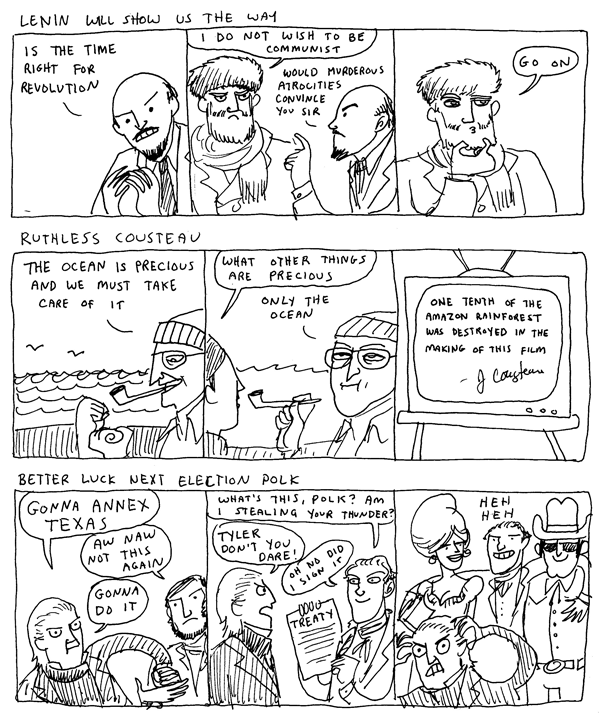
Tyler's the guy who annexes Texas, as one of the last acts of his presidency. It's the main thing he's remembered for, and he totally swipes his successor's campaign promise to do so. He also sends Americans to China, gets us involved with Hawai'i, and his Secretary of State, Daniel Webster, negotiates a treaty with Britain to fix the border between Maine and Canada.

Henry Clay's convinced that Tyler will be the puppet of the Whigs in Congress, but when the National Bank comes up for re-chartering, Tyler vetoes it, much to the ire of Clay, who leads a movement to expel Tyler from the party. Tyler spends the next four years as a president without a party, and in fact, named his Virginia estate "Sherwood Forest" to signify that he had been outlawed by the Whigs. You can visit Sherwood Forest; in fact, Tyler's descendants still live there.

OK, here's your chat for the party: "You know, the Tea Partiers can talk as much as they like about Obama destroying the United States, but John Tyler actually worked to dissolve the Union. See, when Lincoln was elected in 1860 and South Carolina led the move to secede from the Union, Tyler actually led a Peace Commission to try to prevent war--several Northern states and the Southern states which had not yet seceded attended, and while they put forth a package of resolutions at the end of their meetings, Congress rejected them. Then, after war broke out, Tyler sided with his home state of Virginia, and was even elected to the Confederate Congress, although he died before he could take his seat. He's still the only president not to be officially mourned in Washington."

Up next: James K. Polk, who is actually cooler than anyone else at the party (until Honest Abe shows up, of course).

Friday, June 18, 2010

We're Going to Read Another Book This Month.


It's June here, but on our calendar, it's still February, the shortest month. Plenty of time to squeeze in a second president, especially since the first of the month only served for a few weeks. So let's read Edward Crapol's John Tyler: the Accidental President.

Here's the single most interesting thing about Tyler: he's the first man to appoint himself president. Seriously. We now understand the Vice-President to be the natural successor to the President, but when William Henry Harrison drops dead in the spring of 1841, no one has any real idea who gets to be President. Tyler steps up and announces he'll do the job--not as acting President, but as President for the rest of the term. He's headstrong and independent. This will cost him.

Monday, May 3, 2010

Love Story, 1841


What do you say about a 68-year old President who died?

William Henry Harrison died 32 days into his term; he was president from March 4, 1841, to April 4, 1841 (and really, he dies at 12:30 in the morning, so giving him that 32nd day is generous). So how do you write a Presidential Biography about a tenure shorter than the time between haircuts?

I had initially thought about a young reader book (here's a weird thing I've noticed at my public library: there's a kids' book for just about every president, including the obscure ones, the ones they don't have an adult biography for; apparently while some kids are still getting stuck with an assigned report on Millard Fillmore, no sane adult wants to read about him). Then I found Robert M. Owens's Mr. Jefferson's Hammer: William Henry Harrison and the Origins of American Indian Policy. Let's read that, instead, and perhaps if his presidency is uneventful, his life leading up to it won't be.

Thursday, April 1, 2010

Lucky Number Eight?


The wheels of this project grind on, and as we move from Founding Fathers to the Great Blank Space Between Jackson and Lincoln, you can keep up by reading our next selection: Joel H. Sibley's Martin van Buren and the Emergence of American Popular Politics, our next presidential biography.

A funny story about the selection process for this book: when it's possible, I check out both my school's copy and the public library's copy of a book, so that E and I can both read at the same time. It's worked fine up until this point. But while I checked out the public library's copy of Sibley's book, I managed to check out Donald Cole's 1984 biography Martin van Buren and the American Political System. I didn't notice this for a month.

That's not exactly Marx Brother-level hysterics, but it should, if nothing else, give you an idea of van Buren's major contribution to American history.

Friday, August 14, 2009

New Book!


After our mammoth experience with John Adams, we're taking August easy (well, easier) with R. B. Bernstein's Thomas Jefferson, which, to judge a book by its jacket, seems to be exhaustive without being exhausting.

(Also: does titling biographies seem like the easiest job ever? I've reached the point already where something like Ellis's His Excellency, George Washington reads like a Dave Eggers or Sherman Alexie title.)

Tuesday, June 23, 2009

July 2009

Only a week until our next book starts, and while there's plenty more to say about George, it's time to tee up the next book, which, it will come as no surprise to discover, is David McCullough's John Adams.


It's a bio to kill big bugs with, so get ready.

Monday, June 8, 2009

Primary Decisions


According the Library of Congress catalog (which got its start with a president's library, although we'll discuss that in a few months), there are 1,134 biographies of George Washington. Washington's own papers run to a few dozen collected volumes. With so many choices, how do we choose a single biography to read? Can we possibly encompass the width and breadth of 43 presidents' lives in single books when we could easily spend our lives reading about just one?

Well, no. So we've got to pick one. In some cases, the choice is easy, thanks to a recent major biography (David McCullough's John Adams, for example. Or there just isn't much written about the president (William Henry Harrison, I'm looking in your direction). Sometimes we'll let what we can get at the library make the decision for us.

But Washington--well, that's tricky. Lots about him. After some reflection (and digging around Amazon), we've settled on Joseph J. Ellis's His Excellency, George Washington. On the surface, it's got lots going for it--Ellis is a Pulitzer Prize winner for his writings on the Founding Fathers, the almost-four-years-old book is still in Amazon's top 3,000 (not to mention the best-selling bio of GW on the Kindle), and there's even a bit of scandal about Ellis's claims of Washington's relationship with his neighbor Sally Fairfax. But scratch the surface a little, and there's something interesting going on with the author, too; something that might reveal a little about why and how biography gets written.