Showing posts with label Abraham Lincoln. Show all posts
Showing posts with label Abraham Lincoln. Show all posts
Friday, October 19, 2012
The Great One
I've managed exactly two posts in two years, and even that's stretching it--today is the two year anniversary of my post on Franklin Pierce. But there's nothing I hate more than an abandoned blog, so I'm writing again to tackle the big one, the Great Emancipator, Number 16: Abraham Lincoln.
There are so many words written about Lincoln that adding more feels extravagant, like I'm assuming my place in some pantheon of biographers of the man--not my goal at all, I hasten to add. But I do think Lincoln is one of the greatest humans of all time, and the fact that he becomes president is--like Washington's presidency--an example of exactly the right thing happening for America at exactly the right time.
From the slew of books published in time for the 200th anniversary of Lincoln's birth in 2009, I chose Ronald C. White's A. Lincoln: a Biography. I can't recommend it enough. White as a biographer is tremendous interested in Lincoln as a writer, and he analyzes Lincoln's writing as a means of illuminating the man's character. But the most surprising thing from this biography was discovering that Lincoln's voice--the voice which delivered some of the finest speeches in American history (I'm quite fond of the Second Inaugural, personally, although I love the fact that the marker in Gettysburg marking the site of his Address is covered in pennies)--Lincoln's voice was high-pitched, and that he had a habit of flapping his arms when he got worked up. A really wonderful contrast to the Icon of American History that we see so often.
Much of my life seems to have intersected with Lincoln. In Ames, Iowa, I lived on Lincoln Way, part of the old Lincoln Highway, the first auto road to cross America. I've been to the Lincoln Birthplace, the Lincoln Boyhood Home,
Ford's Theater, and Lincoln's Tomb. I bank in a building where he delivered a speech while visiting Union-occupied Fredericksburg in 1862, and every time I come home, I cross paths with Lincoln--my exit from I-95 drops me off at 17th and Main, the same intersection where Lincoln walked through the just-fallen Richmond, just ten days before Booth shoots him. Perhaps more than with any other president, with Lincoln I feel something very close to love.
Lincoln, of course, is notable for being the first Republican president, and one of the things I'm fascinated by is how the Republican Party of 1860 ("We are not enemies, but friends. We must not be enemies. Though passion may have strained it must not break our bonds of affection") becomes the Republican Party of 2012 ("My job is not to worry about those people. I'll never convince them they should take personal responsibility and care for their lives").
Look for my Andrew Johnson post in 2013!

Tuesday, February 21, 2012
Worst. President. Ever.

Just how bad of a president is James Buchanan? So bad that during his term in office, John F. Kennedy said that only those who had been president--"even poor James Buchanan"-- could understand the pressure the office placed upon its occupants. Even the other presidents use James Buchanan as shorthand for terrible.
So writing a biography of him is an overwhelming task--you have very little in the way of the traditional narrative. Buchanan follows the path of other presidents--he's a representative, then a senator, then a minister, then Secretary of State (in fact, he's the last Secretary of State to become President, unless Hillary has something to say in 2016). But then he becomes President, and he's terrible. Two days after he's inaugurated, the Supreme Court hands down the Dred Scott decision, meaning that the federal government has no authority to limit or abolish slavery in the territories. This means that Buchanan throws his support behind the pro-slavery government of the Kansas Territory (which at the time has two governments battling it out for legitimacy). He's what's called a "doughface," a Northerner (still the only President from Pennsylvania) with Southern sympathies.
He sends troops to Utah to fight the Mormons. He proclaims "reform, not relief" during the financial Panic of 1857. Like Pierce, he's so paralyzed by respect for the law that he fails to protect the Union, which is in full collapse when he leaves office in 1861.
Even in the summer of 2010, when I read Philip S. Klein's James Buchanan: a Biography, the 15th president was still difficult. This was the first book that took me two months to read. And Buchanan threw a wrench into my blogging plans, keeping me from it for over a year; I just didn't want to write about the guy. There's something in that stretch of Fillmore-Pierce-Buchanan that's like 2 PM on a Friday. You know something good is coming, but it's so long until it gets there.
All the action in Buchanan's bio happens when Lincoln's elected. The Union is dissolved, as the famous headline put it. And we know the answer to what happens next, but the process is well worth watching. Lincoln's Buchanan's opposite in many ways, but most decisively is his willingness to act.

Monday, August 9, 2010
Polk Salad

Walter Borneman's biography of James K. Polk,
Polk: the Man Who Transformed the Presidency and America, is so well-done and such an effusive biography of #11 that by the end, I was outraged that Polk wasn't on some sort of American money. Surely, a man who pledged himself to four main goals and completed each one in his single term as President, a man who defined the boundaries of America as we know them today (statement valid in continental US only, and let's just ignore the Gadsden Purchase, which isn't that big anyhow), a man who leads America through its first war since the War of 1812, a man who dies 103 days after leaving office having basically worked himself to death--well, that's a man who should be on a $40 bill at least.
Polk's four goals, set out by him at the beginning of his term (March, 1845):
1. Resolve the border dispute with Britain over Oregon.
2. Get California.
3. Lower the tariff.
4. Create an independent treasury.
Here's when he gets these things done:
1. 1846.
2. 1848.
3. 1846.
4. 1846.
To be fair, he does essentially start a war to achieve the second objective. There's a lot of fuss over whether or not American troops are on Texas soil or Mexican soil when they're attacked by the Mexicans. If the former, then it's an aggression; the latter, an invasion on our part. A first-term Whig congressman by the name of Abraham Lincoln makes bold speeches against Polk's war, although the Whigs are generally hamstrung the way the Democrats were when Bush invaded Iraq: how do you argue against the war without seeming like you don't support the troops? Lincoln, in fact, suffers back in Illinois when his constituency sees his arguments against the war as evidence of a lack of patriotism (this should sound really familiar).
Polk's hair is spectacular, surpassed perhaps only by Pierce. The cover of Borneman's book doesn't really do it justice. Here's a photo:

Polk's considered by most (though not Borneman, who seems offended by the idea) to be the first dark horse candidate. In 1844, everyone expects Martin van Buren, the former president, to get the nomination. But the Democrats institute a 2/3 majority rule at the convention, and van Buren's stance against annexing Texas puts too many in opposition to him. Seven ballots go by, and Lewis Cass, pro-Texas, steadily gains votes, but even though their candidate is done, the van Buren voters won't switch. On the 8th ballot, Polk's name is put forward, and he picks up 44 votes. On the 9th, with a little finagling, he gets the unanimous nod.
Here's your party talk on Polk:
"You know, it's interesting how many things we recall from grade school without actually remembering what they mean--like the phrase '54'40" or Fight!' You know it's somewhere in American history, right? It actually refers to the border dispute with Britain over Oregon Territory, which at that time encompassed Oregon, Washington, and British Columbia. The Treaty of 1818, negotiated for America by John Quincy Adams, established the border at 49 degrees, but only east of the Continental Divide. Everyone wanted Oregon--America, Britain, Russia, even Spain for a while. In 1827, Britain and America agree to jointly occupy the place, but Polk comes into office in 1845 ready to settle the matter. If we'd gone for 54'40", then the last winter Olympics would have taken place in America, and you'd be able to drive to Alaska without leaving the US. But Polk and his Secretary of State, James Buchanan, negotiate to extend the 49 parallel to the Pacific Ocean, with a little hitch so all of Vancouver Island stays British. It's settled without a war--which is more than he could do with California."
Polk should be better known. If you're reading along and feel like skipping a few from these years, don't skip this one.
And this is connected to Polk in only the most sonic of ways, but I'm posting it nonetheless.
Sunday, August 8, 2010
A 24 Year Party

I've lived two lives with this project. The first, visible to you, is that of lazy blogger, stuck in 1841 at the beginning of the Tyler Presidency. The second, which you haven't seen, is dedicated reader, 176 pages into this month's biography of Abraham Lincoln. And I've got to tell you, starting the Abraham Lincoln biography was a relief. I knew that something would be up with this project when I realized that between Andrew Jackson (#7) leaving office in 1837 and Abraham Lincoln (#16) taking off in 1861, we went through eight presidents in 24 years: that's a prescription for mediocrity. The last eight biographies--Tyler through Buchanan--have been like being a terrible cocktail party, having to make small talk with people you'd rather avoid: "oh, you went to Bowdoin? With Nathanial Hawthorne? And he later wrote your campaign biography? That's interesting."
And then Lincoln shows up, and it's like your friend just came in the door: "Man, am I glad to see you--these guys are duds. Let's get a beer and talk."
So: I still owe you posts on #10-#16. And while I'm not going to get three posts per president, as I've tried for in the past, I'll give you enough to make small talk at any cocktail party you might go to in the future.
John Tyler, then.
Tyler's the reason the Vice-President becomes President upon the latter's death. When William Henry Harrison dies not long after taking office in 1841 (and pretty much everyone knows he's going to die once he gets sick after the Inaugural), Tyler steps up and asserts his right to the Presidency. Up to that point, no one was really sure if he'd be an Acting President, an Interim President, or still Vice-President performing the President's role. Tyler's foes called him "His Accidency."
Tyler hates Britain so much that when he visits Niagara Falls, he refuses to go see it from the Canadian side.
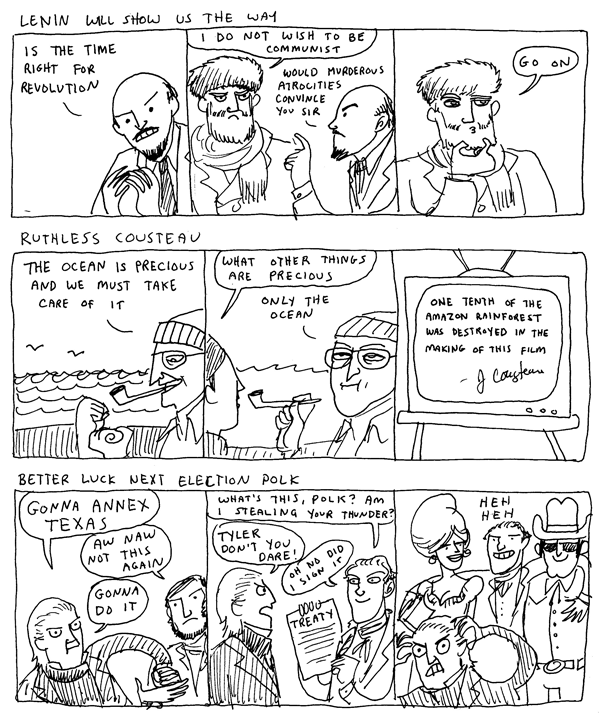
Tyler's the guy who annexes Texas, as one of the last acts of his presidency. It's the main thing he's remembered for, and he totally swipes his successor's campaign promise to do so. He also sends Americans to China, gets us involved with Hawai'i, and his Secretary of State, Daniel Webster, negotiates a treaty with Britain to fix the border between Maine and Canada.
Henry Clay's convinced that Tyler will be the puppet of the Whigs in Congress, but when the National Bank comes up for re-chartering, Tyler vetoes it, much to the ire of Clay, who leads a movement to expel Tyler from the party. Tyler spends the next four years as a president without a party, and in fact, named his Virginia estate "Sherwood Forest" to signify that he had been outlawed by the Whigs. You can visit Sherwood Forest; in fact, Tyler's descendants still live there.
OK, here's your chat for the party: "You know, the Tea Partiers can talk as much as they like about Obama destroying the United States, but John Tyler actually worked to dissolve the Union. See, when Lincoln was elected in 1860 and South Carolina led the move to secede from the Union, Tyler actually led a Peace Commission to try to prevent war--several Northern states and the Southern states which had not yet seceded attended, and while they put forth a package of resolutions at the end of their meetings, Congress rejected them. Then, after war broke out, Tyler sided with his home state of Virginia, and was even elected to the Confederate Congress, although he died before he could take his seat. He's still the only president not to be officially mourned in Washington."
Up next: James K. Polk, who is actually cooler than anyone else at the party (until Honest Abe shows up, of course).
Subscribe to:
Posts (Atom)

 Posts
Posts